

What we are aiming for
At Bassenthwaite, we aim to provide a high-quality computing education that fulfils the requirements of the National Curriculum (2014) and prepares children for life in a rapidly evolving digital world.
Our curriculum is carefully sequenced from EYFS to Year 6 to ensure clear progression in:
- Algorithms and programming
- Networks and digital systems
- Data and information
- Creating digital media
- Digital literacy and online safety
Through computing, pupils learn to design, write, debug and evaluate programs, understand how digital systems and networks function, and use technology safely, respectfully and responsibly.
In the Early Years, computing aligns with Development Matters (2021). Children explore technology in their environment, follow instructions involving several steps, select digital tools for particular purposes and talk about how things work. These early experiences lay the foundations for computational thinking.
As pupils move through school, they learn to:
- Understand what algorithms are and how they are implemented as programs
- Use sequence, selection and repetition (including nested loops)
- Work with variables and different forms of input and output
- Understand computer networks, including the internet and how data is transmitted
- Represent and analyse data, including binary
- Use search technologies effectively and evaluate information critically
Online safety is embedded throughout the curriculum. Children learn to manage personal information, recognise risks, report concerns and behave respectfully in digital spaces.
How learning happens
Mixed-age classes
Computing is taught in mixed-age classes where lessons are carefully planned to ensure progression in both knowledge and skills. Topics are delivered on a rolling cycle to ensure full National Curriculum coverage while allowing children to revisit, deepen and extend prior learning.
Teachers use the school’s progression documents to build cumulatively from EYFS to Year 6. Learning is sequenced so that knowledge of systems, programming structures and data handling increases in complexity over time.
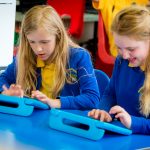
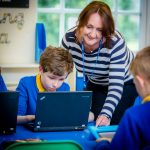
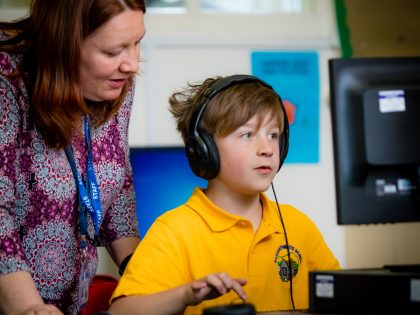
The school is well equipped with desktop computers, laptops and tablets, and all teaching areas have interactive smartboards to enhance engagement and modelling.
How we get there
Computing is taught through structured units that promote exploration, creativity and problem-solving. Lessons begin with a clear objective or challenge, encouraging pupils to think logically and apply prior learning.
Children learn through:
- developing computational thinking (decomposition, pattern recognition, abstraction and logical reasoning)
- designing, writing and debugging programs
- using sequence, selection and repetition
- creating purposeful digital content
- understanding how networks and digital systems work
- collecting, analysing and presenting data
Purple Mash supports our structured progression in programming, data handling, digital creativity and online safety.
Knowledge, vocabulary and computational thinking
Our curriculum develops both:
Substantive knowledge
Understanding how computers, networks and digital systems operate, and how data is represented, stored and transmitted.
Disciplinary knowledge
Applying computational thinking skills such as:
- Decomposition
- Pattern recognition
- Abstraction
- Algorithm design
- Logical reasoning
- Evaluation and refinement
Key vocabulary is explicitly taught and revisited so children can explain their understanding clearly and confidently. Teachers model new concepts and provide opportunities for guided practice before independent application.
Computing is used across the wider curriculum where appropriate to enhance learning and support creativity.
What children gain
Through our computing curriculum, children:
- Develop confidence using a range of digital devices and software
- Become logical and resilient problem-solvers
- Design, write and debug increasingly complex programs
- Understand how digital systems and networks function
- Create purposeful digital content
- Learn to evaluate online information critically
- Develop independence, responsibility and respect online
Computing contributes to children’s spiritual, moral, social and cultural development by promoting responsible decision-making, collaboration and respectful communication in digital environments.
By the time they leave Bassenthwaite, pupils are digitally literate, confident and well prepared for secondary education and modern life.
How we know
We know children are making progress in computing through:
- Increasing complexity in programming and problem-solving
- Greater independence in debugging and refining work
- Accurate use of computing vocabulary
- Ability to explain how digital systems and algorithms work
- Quality and purpose of completed digital outcomes
Teachers assess learning through:
- Observation of practical skills
- Review of digital work and projects
- Discussion and questioning
- Evaluation and refinement of outcomes
Ongoing assessment and retrieval ensure knowledge is secure and builds cumulatively over time.
How you can help at home
Parents and carers play an important role in helping children use technology safely, confidently and responsibly.
- Talk regularly about online life
Encourage open conversations about what your child does online and who they interact with. - Set simple, clear boundaries
Agree family rules for screen time and app use. - Use privacy and safety settings
Check settings together and explain why they matter. - Encourage kindness and respect online
Discuss respectful communication and responsible sharing. - Promote creative use of technology
Encourage your child to create digital art, presentations, animations or simple programs.
Parents and carers may find the following websites useful:
UK Safer Internet Centre
Advice and resources to support safe, positive and responsible internet use.
https://saferinternet.org.uk/guide-and-resource/parents-and-carers
Childnet
Practical guidance, conversation starters and online safety resources.
https://www.childnet.com/parents-and-carers/
NSPCC – Online Safety
Information about social media, gaming, apps and parental controls.
https://www.nspcc.org.uk/keeping-children-safe/online-safety/
Internet Matters
Step-by-step guides for parental controls and digital wellbeing.
https://www.internetmatters.org/
BBC Bitesize – Computing
Child-friendly explanations, videos and activities.
https://www.bbc.co.uk/bitesize/subjects/zvc9q6f
Regular conversations about online experiences help children build safe, confident and positive digital habits.